
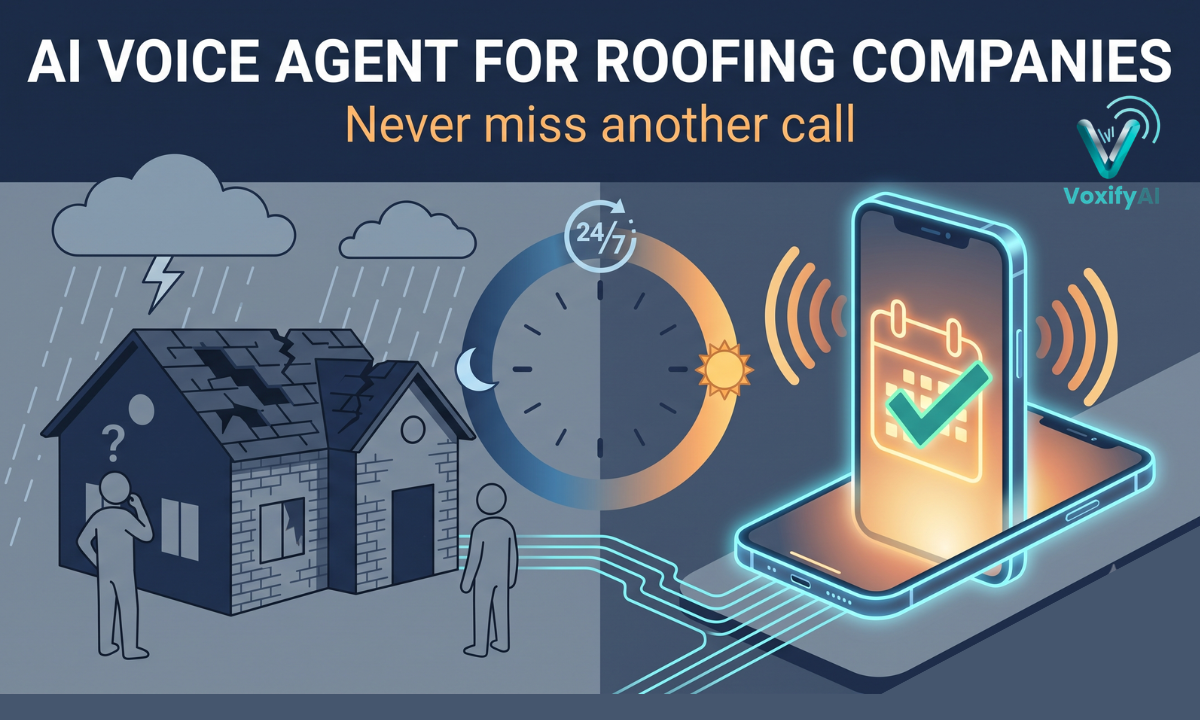
It’s 9 p.m. on a Tuesday. A homeowner’s ceiling has a slow drip spreading across the drywall. She grabs her phone and calls the first roofing company that shows up in her search. It rings. And rings. Then it drops to voicemail.
She doesn’t leave a message. She calls the next name on the list.
That scene plays out thousands of times a day across the roofing industry, and it’s quietly draining more revenue than bad marketing, weak pricing, or slow crews ever could. The fix isn’t a bigger ad budget — it’s making sure every single call gets answered, day or night, storm or no storm. That’s exactly what an AI voice agent for roofing companies is built to do.
The Real Cost of a Missed Call in Roofing
Most roofing business owners underestimate how much a single unanswered ring actually costs them. The numbers tell a different story:
- Roofing companies miss roughly 25–30% of inbound calls on average, and that rate climbs even higher during peak season when crews are on rooftops and the office phone goes unanswered.
- Once someone doesn’t get through, the damage is nearly permanent—an overwhelming majority of callers who hit voicemail simply hang up and dial the next roofer on their list rather than leaving a message.
- Because the average residential roofing job runs anywhere from $8,000 to $15,000+, a single missed call isn’t a minor inconvenience — it’s a five-figure opportunity walking out the door.
- Storm season makes everything worse. Call volume can spike 300–500% in the 48–72 hours after a major weather event, right when your team is least able to answer the phone.
Run the math on a mid-sized roofing company missing even 10 real leads a month, and you’re looking at six figures in lost revenue annually—money that never shows up as “lost” because it simply never rang through in the first place.
Why Roofing Calls Are Different From Other Home Service Calls
Not every missed call is created equal, and roofing sits near the top of the urgency scale. A homeowner calling about a leak or storm damage isn’t casually comparison shopping—they’re in problem-solving mode, often dealing with an active issue or an insurance deadline. Research on speed-to-lead consistently shows that leads contacted within the first five minutes convert dramatically better than those reached even thirty minutes later. In roofing, that window is often even shorter, especially during weather events when a homeowner is calling multiple contractors back-to-back and awarding the job to whoever answers first.
That’s the core problem a traditional office setup can’t solve: your best salespeople are on ladders, not phones.
What an AI Voice Agent Actually Does for a Roofing Business
An AI voice agent isn’t a robotic phone tree or a glorified voicemail greeting. It’s a conversational system that picks up every call in real time, understands what the caller needs, and takes the right next step—automatically.
For a roofing company, that typically looks like:
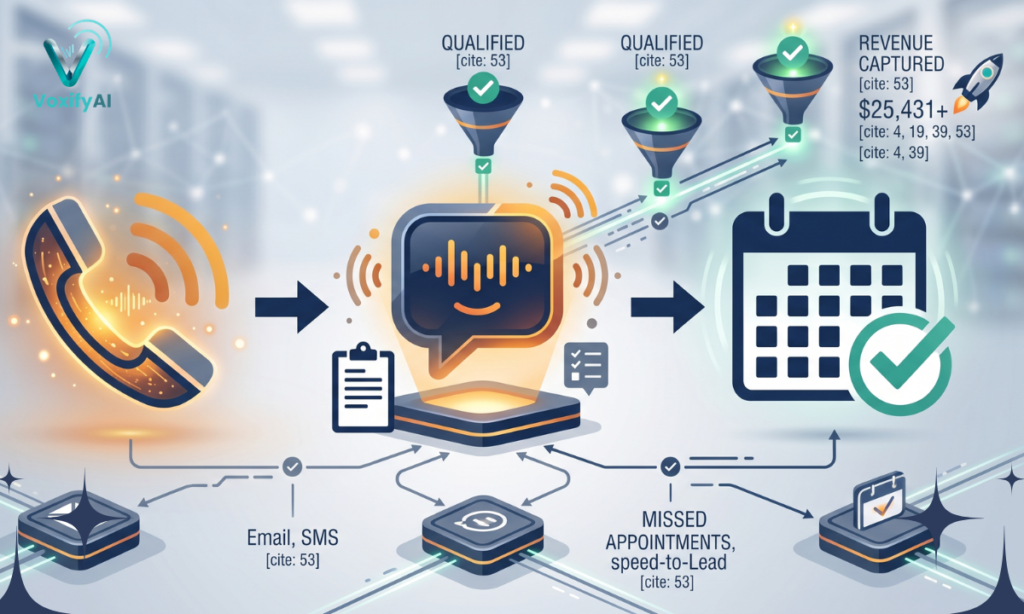
Answers every call instantly, 24/7. No more voicemail during storm surges, weekends, or after 5 p.m. — the exact windows when homeowners are most likely to call and least likely to wait.
Qualifies the lead on the spot. The agent asks the right questions—type of issue, urgency, property address, insurance involvement—so your team gets a fully qualified lead instead of a vague voicemail.
Books the estimate directly onto your calendar. Instead of a callback loop, the caller schedules an inspection in the same conversation, synced straight into your existing scheduling tool.
Triages emergencies from routine requests. An active leak gets flagged and escalated immediately; a general estimate request gets booked in the normal queue—so your team isn’t woken up for every call.
Hands off, with full context, when a human is needed. If a call needs a real person, the agent passes along a transcript and details so the homeowner never has to repeat themselves.
Scales instantly during storm season. Where a two-person office can only handle so many simultaneous calls, an AI voice agent can answer dozens of calls at once—exactly when call volume spikes hardest.
The ROI Math Is Hard to Ignore
Compare the numbers: a single missed roofing job can cost $8,000–$15,000 in lost revenue. A dedicated AI voice agent typically runs a fraction of the cost of one full-time office hire, with no sick days, no training time, and no scheduling gaps. For most roofing companies, recovering even one or two additional jobs a month covers the entire cost of the system many times over — and everything after that is pure upside.
It’s also worth comparing to traditional answering services. Live call centers are often billed per minute and staffed by operators unfamiliar with roofing terminology—misheard terms like “flashing,” “TPO,” or “architectural shingles” create confusion that slows down the sales process. A well-built AI voice agent, trained specifically on your services and vocabulary, avoids that friction entirely.
What to Look for When Choosing an AI Voice Agent for Your Roofing Business
Not all solutions are built the same. Before committing, roofing companies should look for:
- Sub-few-second response time—a caller who hears dead air will hang up just as fast as if the call had gone unanswered.
- CRM and calendar integration — leads and bookings should sync automatically into the systems your office already uses, with zero manual data entry.
- Storm-mode capability — the ability to handle sudden 5–10x call spikes without degrading call quality.
- Custom vocabulary training — the agent should understand roofing-specific terms, materials, and insurance language from day one.
- Transparent escalation logic — clear rules for when a call gets handed to a human, with full conversation context passed along.
Frequently Asked Questions
Does an AI voice agent sound robotic?
Modern AI voice agents use natural, conversational speech patterns designed to sound like a real front-desk employee—most callers don’t realize they’re speaking with AI.
Can it handle emergency storm calls differently from routine estimate requests?
Yes. A properly configured system triages calls by urgency, flagging active leaks or storm damage for immediate attention while routing general inquiries into your normal booking flow.
How fast can a roofing company get one set up?
Most implementations go live in a matter of days to a few weeks, depending on how deeply it needs to integrate with your existing CRM and calendar tools.
Will it replace my office staff?
No—it’s designed to eliminate the calls that currently go unanswered, not replace the team handling calls you already catch. Most roofing companies use it to cover after-hours, overflow, and storm-surge volume while their staff focuses on higher-value conversations.
The Bottom Line
Every ring your roofing company doesn’t answer is a job someone else books instead. In an industry where the first contractor to pick up the phone usually wins the work, an AI voice agent isn’t a nice-to-have — it’s the difference between a marketing budget that pays for itself and one that quietly leaks revenue every single day.
If you’re ready to stop losing storm-season leads to voicemail, VoxifyAI builds custom AI voice agents specifically for roofing and home-service businesses—answering every call, qualifying every lead, and booking every estimate, 24/7.