
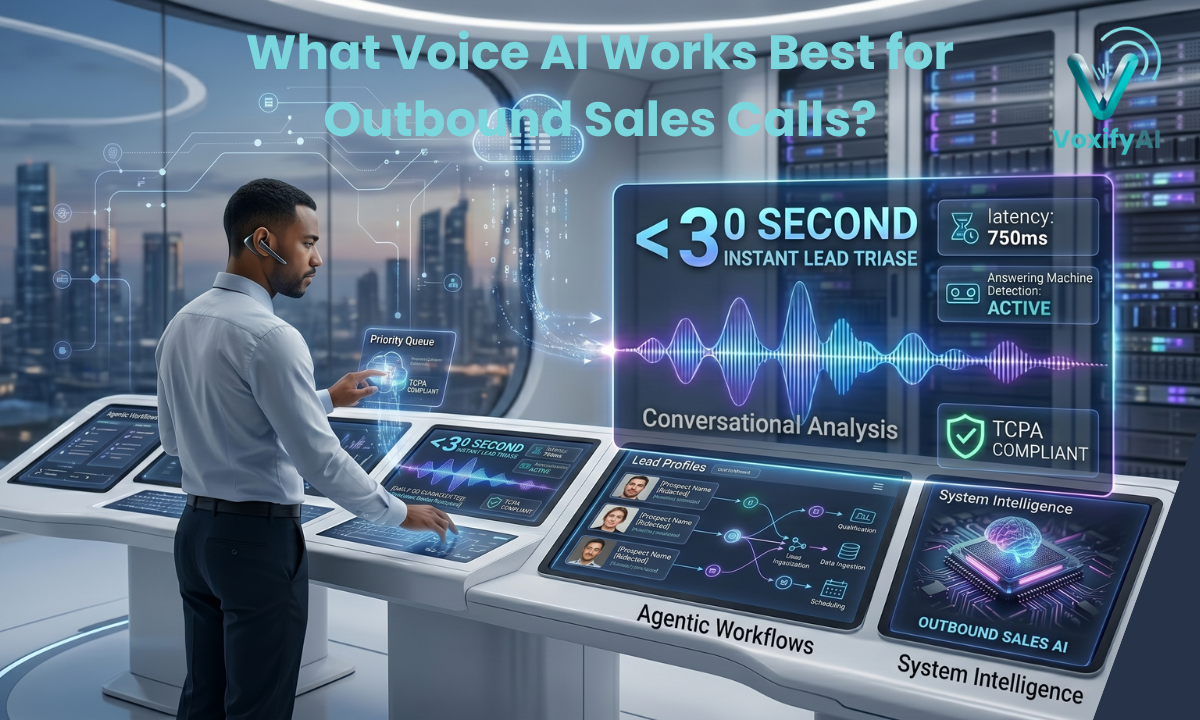
The best Voice AI framework for outbound sales calls combines an ultra-low latency execution engine (such as RetellAI or Bland AI) with a custom orchestration layer (built using tools like n8n or Make.com) to drive deep CRM integrations. For US-based outbound campaigns, success depends on sub-800ms response times, native batch-dialing features, verified Caller ID to bypass spam filters, and strict TCPA compliance safeguards.
The Cold Outreach Crisis: Why Standard Voice Bots Fail
Outbound cold calling and lead qualification are numbers games that have historically suffered from massive human overhead. If an inside sales team takes 15 to 30 minutes to follow up with an inbound lead, the conversion probability drops by over 300%.
Many growth-focused enterprises try to solve this speed-to-lead bottleneck by throwing basic conversational bots or legacy Interactive Voice Response (IVR) systems at the problem. The result? High call-abandonment rates, ruined domain reputations, and zero sales pipeline growth.
Outbound sales calls are structurally much harder than inbound support calls. In an inbound environment, the caller wants to talk to you. In an outbound sales environment, you have less than 3 seconds to establish authority, handle interruptions, bypass voicemail boxes, and avoid sounding like a synthetic robocaller.
To determine what voice AI works best for outbound sales, we must look past marketing claims and evaluate the technology across the four core pillars of enterprise outbound engineering.
1. Latency & Interruption Handling: The Sub-800ms Rule
If your outbound voice agent pauses for more than 1 second after a prospect says “Hello?”, the call is dead. The prospect will immediately hang up, realizing they are talking to a machine.
To feel completely human, an outbound sales agent requires a total turnaround latency of 600ms to 800ms. This latency budget includes three distinct technological components:
- Speech-to-Text (STT): Fast transcription engines (like Deepgram Nova-2) turning the prospect’s spoken voice into text.
- LLM Processing (The Brain): Ultra-fast inference models (such as GPT-4o or specialized Groq-hosted open-source models) processing the text and generating a response.
- Text-to-Speech (TTS): Premium, emotionally expressive streaming voice engines (like ElevenLabs v3 or Cartesia) speaking back to the prospect.
Platform Breakdown for Outbound Flow:
- RetellAI: Widely considered the front-runner for outbound sales conversions due to its specialized, custom-built conversational pipeline. It optimizes the interaction between the STT, LLM, and TTS layers to keep latency consistently under 700ms. More importantly, it features advanced live context retention and interruption handling. If a prospect cuts off the agent mid-pitch to say, “Wait, who is this?”, the agent stops instantly, acknowledges the interruption naturally, and shifts context without rebooting the conversation script.
- Bland AI: Exceptional for raw, high-volume outbound engineering. It is optimized to manage massive concurrent call loads simultaneously, making it a strong choice for broad cold-outreach campaigns that require running hundreds of dials at once.
- Vapi: Offers unmatched flexibility for developers who want to hand-pick every single micro-service (BYOK – Bring Your Own Keys). However, building out complex sales logic and robust context retention on Vapi requires significantly more custom development overhead.
2. Telephony Features Built for Outbound Delivery
The best conversational brain is completely useless if your phone calls never actually reach the prospect. Outbound operations in 2026 must actively fight against carriers marking business numbers as “Spam Likely.”
When evaluating an outbound voice platform, ensure the following telephony architectures are natively supported out of the box:
- Batch Calling & Elastic Scaling: The infrastructure must allow you to upload a CSV file of 1,000 lead profiles and execute those concurrent outbound dials instantly, without server throttling or drop-offs.
- Branded Caller ID & SHAKEN/STIR Verification: Platforms like RetellAI provide verified, clean phone numbers out of the box. This ensures your outbound dials show up on a prospect’s mobile device with your company’s legal name, instantly boosting call-answer rates by up to 40%.
- Answering Machine Detection (AMD): The voice agent must be capable of identifying a live human voice vs. an automated voicemail greeting within the first 500 milliseconds. If it hits a voicemail, it must seamlessly hang up without burning billing minutes, or drop a pre-recorded, hyper-personalized audio message.
3. Deep Workflow Integration: Turning Conversations into CRM Actions
An outbound sales agent should never operate in isolation. The true value of modern automation lies in Glue Engineering—connecting the voice infrastructure directly to your operational software stack via APIs and tools like n8n or Make.com.
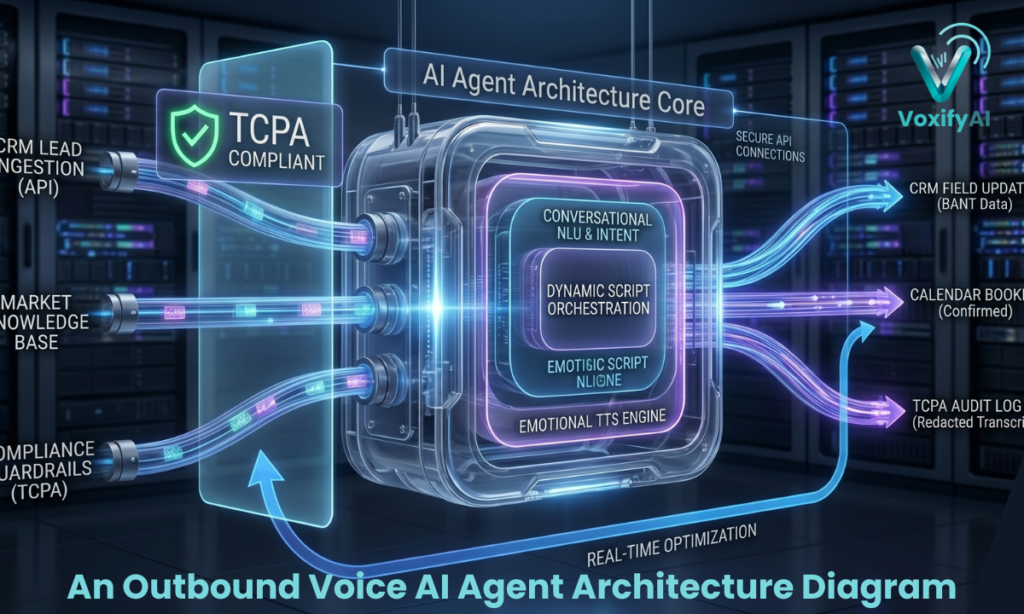
The Ideal Outbound Sales Stack Architecture:
[ Lead Database / CRM ] ──► Triggers Outbound Call via API ──► [ RetellAI / Bland Engine ]
│
[ Live CRM Field Update ] ◄── Saves Transcripts & Answers ◄────────────────┤ (Fluid Call)
[ Booking & Action Trigger ] ◄── Schedules Follow-Up on Calendar ◄─────────┘
When VoxifyAI designs an outbound workflow, the voice agent is fully weaponized with automated tool-calling capabilities:
- Real-Time Data Ingestion: As the prospect states their budget, pain points, or timeline, the AI updates individual, structured data fields directly inside HubSpot, Salesforce, or GoHighLevel (GHL) in real time.
- Instant Calendar Booking: If the prospect meets your BANT (Budget, Authority, Need, Timeline) qualification framework, the agent dynamically checks your sales team’s availability and places a meeting directly onto the calendar during the call.
- Omnichannel Multi-Tasking: The moment the call ends, the agent automatically sends a summary text message and follow-up email containing the calendar invite link, moving the prospect smoothly down the sales funnel.
4. Compliance: Navigating TCPA and Regulatory Guardrails
Outbound calling in the United States is strictly regulated. Executing uncompliant outbound automation is an easy way to incur massive legal penalties. The system you implement must support a Security-First Architecture:
- TCPA & FCC Safeguards: The voice agent must have built-in operational constraints, ensuring calls are only placed within legally permissible regional hours.
- SOC 2 Type II Compliance: Financial, healthcare, and enterprise sales data must be heavily encrypted both in transit and at rest.
- PII Redaction: The platform should feature automated string scrubbing to redact sensitive variables (like social security numbers or credit profiles) from written transcripts before they hit permanent storage logs.
Technical Performance Matrix
| Evaluation Criteria | Template-Based Voice Bots | Custom Voice AI Stack (VoxifyAI) |
| Response Turnaround Latency | 1.5 to 2.5 seconds (Awkward gaps) | 600ms – 800ms (Fluid, human-like) |
| Interruption Recovery | Fails or talks over the user | Instantly pauses and adapts context |
| Call Deliverability | Gated or flagged as spam likely | Verified SHAKEN/STIR & Branded Caller ID |
| CRM Infrastructure Syncing | Basic text logs pasted into a note | Structural data field populating via API |
Frequently Asked Questions (FAQ)
Can an AI voice agent close high-ticket B2B sales entirely on its own?
For complex, high-ticket B2B offers, we recommend a Hybrid SDR Model. The AI Voice Agent acts as the ultimate outbound Sales Development Representative (SDR)—cold-calling lists, following up on inbound forms under 10 seconds, scrubbing out unqualified leads, and passing hot, pre-vetted opportunities onto your calendar for a live human closer to sign.
What happens if a prospect realizes they are talking to an AI?
Modern neural voices are incredibly realistic, but if a prospect asks directly, the agent is programmed to be honest: “Yes, I am an AI assistant built to save you time and check your availability quickly. I can still book your showing right now—does Thursday work better for you?” This transparency builds immediate professional trust while maintaining high conversion rates.
What is the actual runtime cost per minute for a production outbound agent?
While base software costs hover around $0.05 to $0.07 per minute, a production-level outbound agent (factoring in top-tier LLMs, high-quality ElevenLabs voice streams, and standard telephony carrier routing) typically costs between $0.15 and $0.35 per call minute. This represents an operational cost reduction of over 80% compared to traditional human call center staffing.
Stop Waiting for Leads to Go Cold
The best outbound voice AI platform isn’t just an app you log into—it’s a customized, deeply integrated system built specifically around your sales criteria. By weaponizing low-latency frameworks like RetellAI alongside elite workflow engineering, you can ensure that your business scales its outbound outreach infinitely without increasing its headcount.
[Schedule an Outbound Automation Audit with VoxifyAI] and hear a custom live demo built for your industry.