
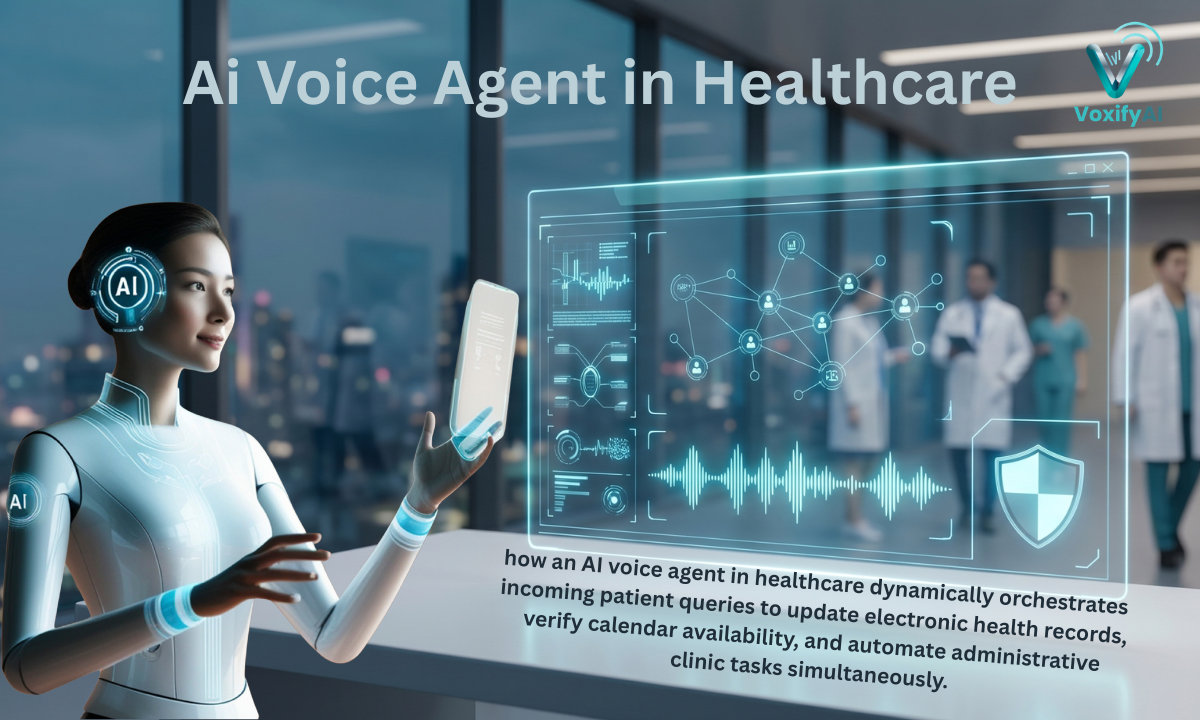
Deploying an AI voice agent in healthcare requires shifting from simple automated answers to true agentic clinical workflows. To maximize patient conversion and retention, modern healthcare systems must integrate low-latency voice models with specialized medical software, enforce granular electronic health record (EHR) data syncing, and implement bulletproof HIPAA and data isolation frameworks.
The Operational Bottleneck in Modern Medical Practices
The operational strain on American healthcare clinics has reached a critical tipping point. Medical receptionists and front-desk staff are consistently overwhelmed by high call volumes, resulting in extended hold times, patient frustration, and a measurable surge in patient leakage. When a patient calling to schedule an appointment or confirm a referral faces an administrative bottleneck, they frequently hang up and look for an alternative provider.
Historically, clinics attempted to solve this issue with legacy Interactive Voice Response (IVR) systems. However, rigid touch-tone menus often alienate patients, forcing them through complex navigation layers only to end up leaving a voicemail.
Deploying a production-grade AI voice agent in healthcare changes this dynamic entirely. Instead of acting as a passive voice recorder, an intelligent conversational agent functions as an automated, highly synchronized extension of the clinical team—available instantly, around the clock, with zero operational delay.
1. Designing the Clinical Conversation: Inbound Triage Logic
Unlike general commercial sales funnels, healthcare communication requires an empathetic, highly structured, and deterministic dialogue flow. A patient calling a clinic may be experiencing vulnerability or urgent discomfort, meaning the conversational interface must balance clinical precision with a smooth, reassuring user experience.
Advanced conversational systems utilize sophisticated natural language understanding (NLU) nodes to triage calls based on intent:
- Urgent Care Escalation: The agent must immediately recognize high-risk phrases or medical emergencies. If a patient mentions severe, sudden symptoms, the agent bypasses standard automated scripts to execute an immediate live transfer to an on-call nurse or emergency service lines.
- Routine Patient Inquiries: For standard tasks—such as updating insurance details, checking clinic business hours, or requesting basic prescription refills—the agent provides direct, instantaneous resolutions without taxing internal staff.
By managing the early stages of data gathering over the phone, the agent effectively clears the administrative queue, allowing live clinic personnel to dedicate their time to in-office patient care.
2. Technical Synchronization: Connecting Voice to the EHR and Calendar
An effective voice agent cannot operate within an isolated silo; it must actively communicate with the core software systems that power the medical practice. This requires deep integration with electronic health records (EHR), practice management software (PMS), and automated scheduling systems via secure API layers.
When an agent handles an administrative task, the backend architecture handles multiple technical processes concurrently:
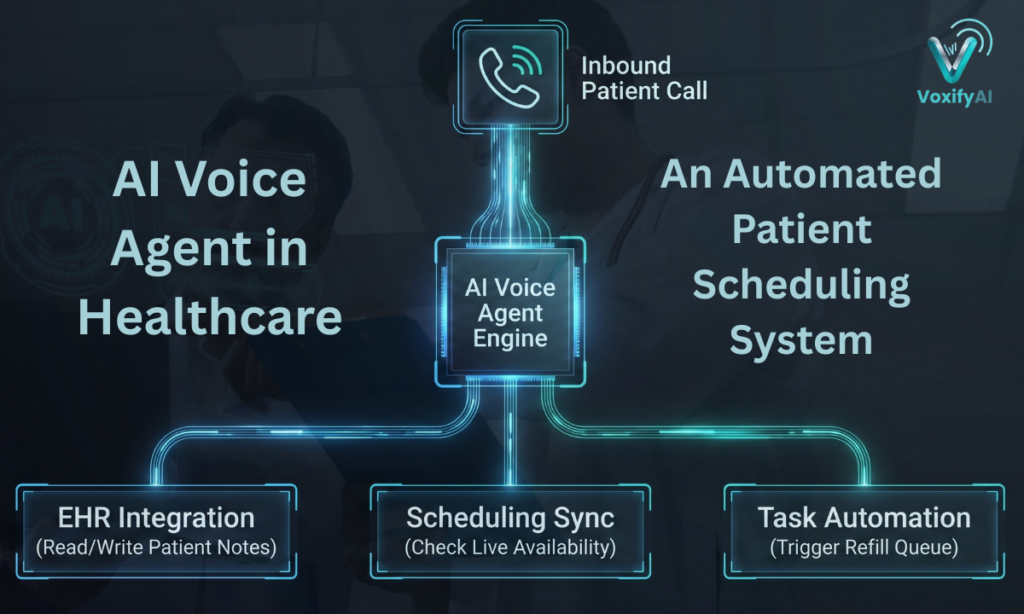
- Bi-Directional Scheduling: When a patient asks to book or reschedule a visit, the agent calls custom tool functions to check live calendar software availability. It securely cross-references open time slots within platforms like Cal.com, Athenahealth, or Epic Systems and books the slot directly, entirely eliminating overbooking risks.
- Automated Record Updating: As the conversation progresses, the agent maps structural data points—such as verified contact numbers, updated mailing addresses, or specific cancellation reasons—and writes them directly into the patient’s centralized digital file, keeping internal databases thoroughly optimized.
3. Strict Data Governance: Enforcing HIPAA and Financial Security Guardrails
Operating an enterprise-level voice system within the United States medical sector demands strict compliance with federal regulations. Because patient interactions naturally involve protected health information (PHI) and personally identifiable information (PII), security must be natively woven into the software architecture.
When deploying a voice automation stack, several essential security parameters must be maintained:
- Comprehensive Business Associate Agreements (BAAs): Every piece of the software stack—from the speech-to-text transcriber to the core language models—must be backed by legal BAAs to guarantee that data processing aligns strictly with HIPAA compliance mandates.
- Automated Log Scrubbing and Redaction: While the voice model requires real-time data access to guide the conversation, permanent storage structures must immediately redact sensitive medical or financial terms from text logs and summaries once the interaction is concluded.
- Dedicated Data Isolation: Patient data must never be cached, retained, or utilized by external platforms for public large language model training. Every transaction must remain entirely isolated within the clinic’s private, encrypted network cloud.
4. Key Performance Benchmarks for Clinical Voice Automation
To accurately measure the operational return on investment (ROI) of a healthcare voice deployment, clinic operators must monitor specific system performance metrics rather than standard customer service variables:
| Operational Metric | Traditional Clinic Front Desk | Advanced AI Voice Layer |
| Simultaneous Call Capacity | Gated by phone lines & staff count | Scalable to hundreds of concurrent calls |
| Response Latency | Variable (Prone to hold times) | Sub-800ms fluid conversation flow |
| Average Speed-to-Resolution | 3 to 6 Minutes (Due to manual lookups) | Under 90 Seconds via automated database queries |
| Data Capture Integrity | Prone to manual typos or incomplete files | 100% accurate API-driven data syncing |
Frequently Asked Questions (FAQ)
Can an AI voice agent handle patient check-ins and intake forms?
Yes. The agent can be programmed to call outbound to patients scheduled for upcoming appointments to confirm their check-in time, verify their current health insurance details, and send a direct link to digital intake forms via SMS, ensuring a friction-free experience when they arrive at the clinic.
How does the agent handle accents or complex medical terminology?
Modern speech-to-text engines are highly optimized with custom clinical vocabularies, enabling them to interpret complex medical terms, drug names, and various regional accents with exceptional accuracy, minimizing conversational misunderstandings.
What is the workflow if a patient explicitly demands to speak to a human?
The system utilizes a structured fallback protocol. If a patient indicates they prefer human assistance, the agent gracefully pauses the automated flow, states that it is initiating a transfer, and immediately routes the call to the appropriate internal department line alongside the real-time transcript summary.
Optimize Your Practice’s Communication Pipeline
Implementing an advanced, compliant voice system allows medical organizations to recapture valuable administrative hours, eliminate phone-based patient churn, and scale overall booking capacity without forcing staff into severe operational burnout. In modern practice management, the clinics that grow are the ones that prioritize frictionless, instantaneous patient access.
[Schedule a consultation with VoxifyAI] to review your practice’s communication workflow and see a live demonstration of a secure, custom-built healthcare voice agent.