
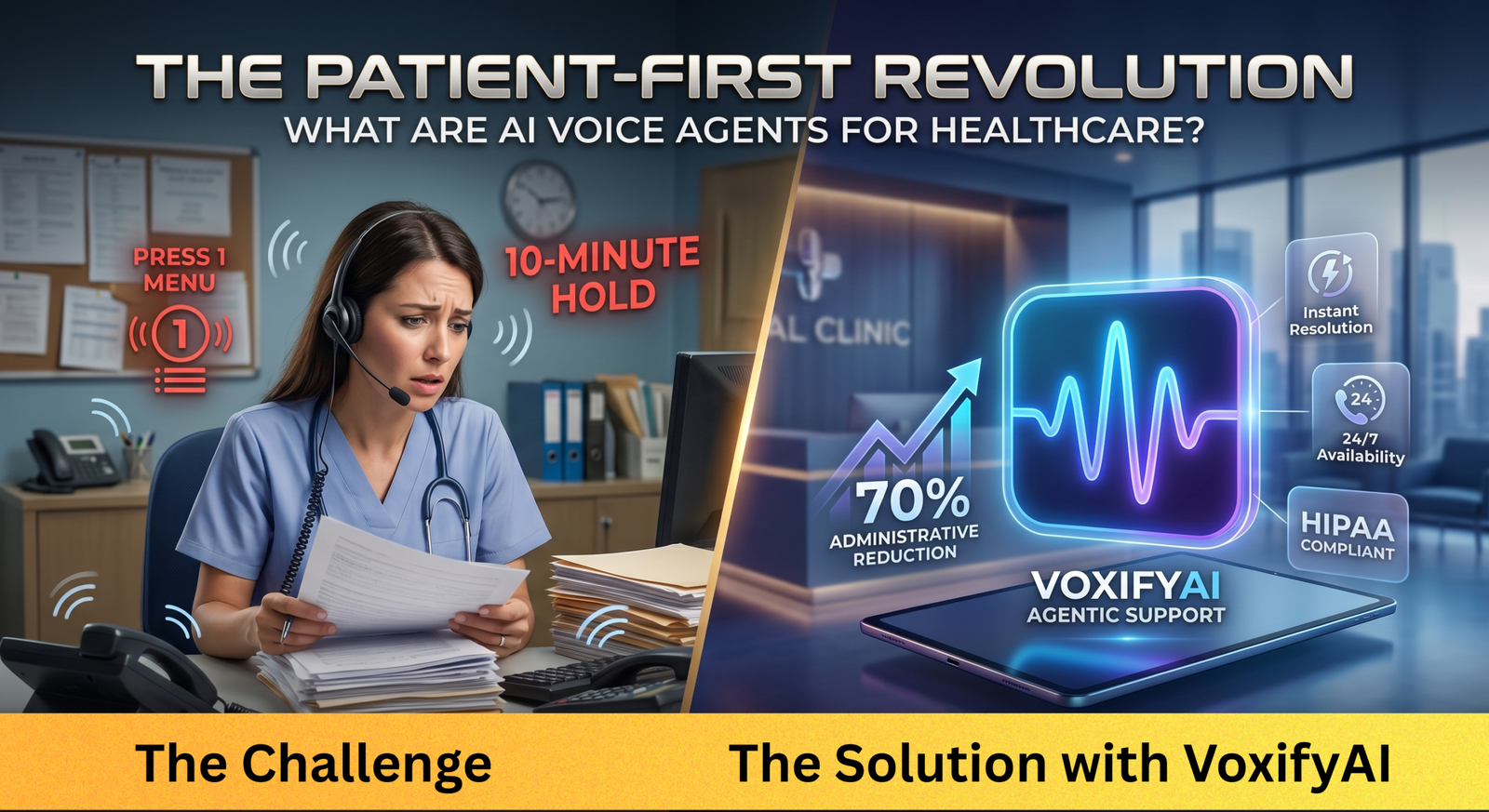
AI Voice Agents for healthcare are secure, HIPAA-compliant conversational systems that manage patient interactions—such as scheduling, refills, and triage—using natural language. By eliminating hold times and automating administrative “grunt work,” these agents allow US clinics to reclaim up to 60% of their staff’s time while significantly improving patient access to care.
Moving Beyond the “Digital Divide” in Medicine
For decades, the healthcare industry has struggled with a paradox: as medical technology advanced, the “front door” of the clinic—the telephone—remained stuck in the 1990s. Patients seeking care are still met with clunky “Press 1 for Dental” menus or, worse, the dreaded 15-minute hold music.
In 2026, this is no longer just a minor inconvenience; it is a clinical bottleneck. When a patient can’t reach their doctor, they delay care, skip appointments, and lose trust.
AI Voice Agents represent the first true solution to this crisis. These are not the robotic bots of the past. They are sophisticated, “agentic” systems capable of listening, reasoning, and executing tasks with the same nuance as a highly trained medical receptionist.
1. What Exactly is a Healthcare AI Voice Agent?
At its core, a Healthcare AI Voice Agent is a software entity powered by Natural Language Understanding (NLU) and Generative AI. Unlike a traditional phone tree (IVR) that forces a patient to follow a rigid path, an AI agent allows the patient to lead the conversation.
Imagine a patient calling at 2:00 AM. Instead of a voicemail, they hear a calm, professional voice: “Hi, you’ve reached the clinic. How can I help you today?” The patient can speak naturally: “My name is Sarah, and I need to reschedule my cleaning for Tuesday because my car is in the shop. Do you have anything on Thursday morning?” The AI doesn’t just “transcribe” this; it understands it. It checks the practice management software, identifies a 10:00 AM slot on Thursday, confirms the change, and sends an SMS reminder—all in under 45 seconds.
2. The Four Pillars of Medical Automation
To understand the value of this technology, we must look at the four primary areas where VoxifyAI agents are currently transforming US practices:
A. Intelligent, Bi-Directional Scheduling
The “scheduling dance” takes up 40% of a front-desk agent’s day. AI agents integrate directly with platforms like Epic, AthenaHealth, and Open Dental. They don’t just “take a message”; they write directly to the calendar, ensuring zero double-bookings and instant confirmation.
B. Prescription Refill Automation
Refill requests are high-volume, low-complexity tasks that bog down nursing staff. An AI agent can verify the patient’s identity via DOB and phone number, confirm the medication name, and push the request to the provider’s “Pending” queue for a one-click approval.
C. HIPAA-Compliant Insurance Verification
One of the biggest causes of billing delays is incorrect insurance data. AI agents can ask a patient to “read their member ID” or even send a secure link via SMS for the patient to upload a photo of their card, which the AI then parses and uploads to the patient file.
D. Post-Operative & Preventive Outreach
Healthcare is moving toward “Proactive Care.” AI agents can conduct “Check-in Calls” after a procedure: “Hi Sarah, Dr. Smith wanted to see how your recovery is going today. On a scale of 1 to 10, how would you rate your discomfort?” Based on the answer, the AI can either offer reassurance or immediately escalate the call to a live nurse.
3. The Security Barrier: HIPAA, SOC2, and Data Integrity
In the US healthcare market, “AI” often triggers “Anxiety” regarding data privacy. To rank as a leader, you must address this head-on.
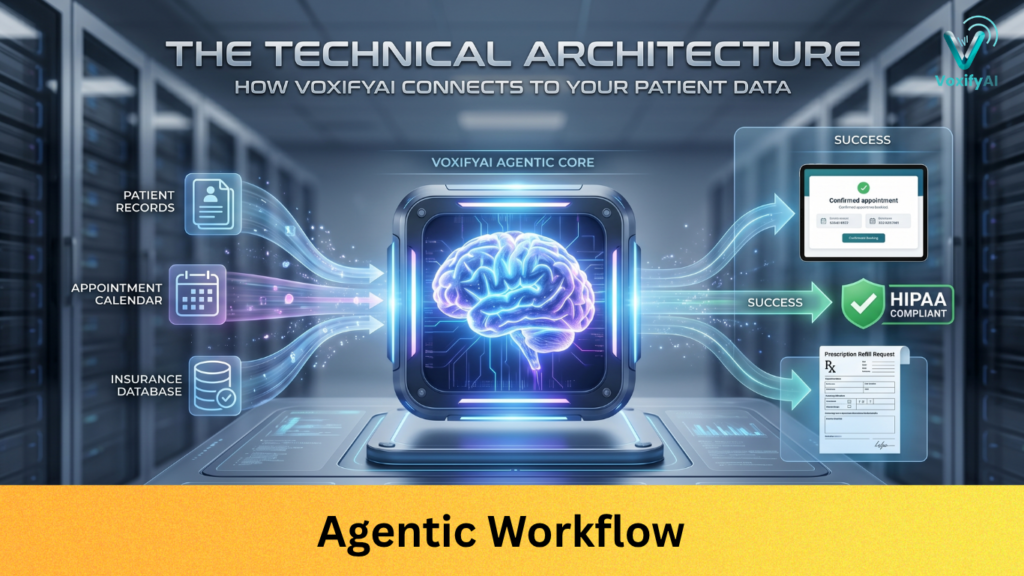
VoxifyAI agents are built with Security-by-Design:
- Data Redaction: Our systems use “Personally Identifiable Information (PII) Scrubbing.” If a patient mentions their Social Security Number, the AI processes the logic but redacts the number from the permanent transcript.
- Encrypted “Silky” Transitions: Voice data is encrypted at the 256-bit level. We ensure that your patient data never “trains” public AI models, keeping your practice’s proprietary information—and your patients’ secrets—private.
4. AI Voice Agents vs. Traditional IVR: The ROI Breakdown
Many office managers ask: “Why not just use a cheaper IVR system?” The answer lies in the Hidden Cost of Frustration.
| Metric | Traditional IVR | VoxifyAI Agent |
| Call Abandonment | 35% – 50% | < 5% |
| Average Handling Time | 3-5 Minutes | < 1 Minute |
| Resolution Rate | 20% (mostly routing) | 75% (actual task completion) |
| Patient Satisfaction (NPS) | Low (Frustrating) | High (Efficient & Empathetic) |
The Bottom Line: An IVR is a “Traffic Cop” that moves the problem around. An AI Agent is an “Employee” that solves the problem.
5. Frequently Asked Questions (FAQ)
Is the voice “robotic”?
In 2026, no. We use Neural Text-to-Speech (TTS) with adjustable “emotional prosody.” You can choose a voice that sounds warm, authoritative, or clinical, depending on your practice’s brand.
What if a patient has a medical emergency?
Safety is our top priority. We implement Keyword Trigger Protocols. If a patient mentions “chest pain,” “heavy bleeding,” or “suicidal thoughts,” the AI immediately breaks the automation and either routes the call to an emergency line or instructs the caller to hang up and dial 911.
How do we get our staff to accept the AI?
The biggest mistake is thinking AI replaces people. We frame it as “Staff Amplification.” By letting the AI handle the “boring” 80% of calls, your human staff can finally focus on the 20% of patients who are actually in the office, providing the face-to-face care that truly matters.
Conclusion: The Future of the “Always-Open” Clinic
The most successful medical practices in 2026 will be those that realize their front desk shouldn’t have “business hours.” Patients get sick at 11:00 PM; they worry about their bills at 6:00 AM.
By implementing AI Voice Agents for healthcare, you are effectively telling your patients: “We are here for you, whenever you need us.