
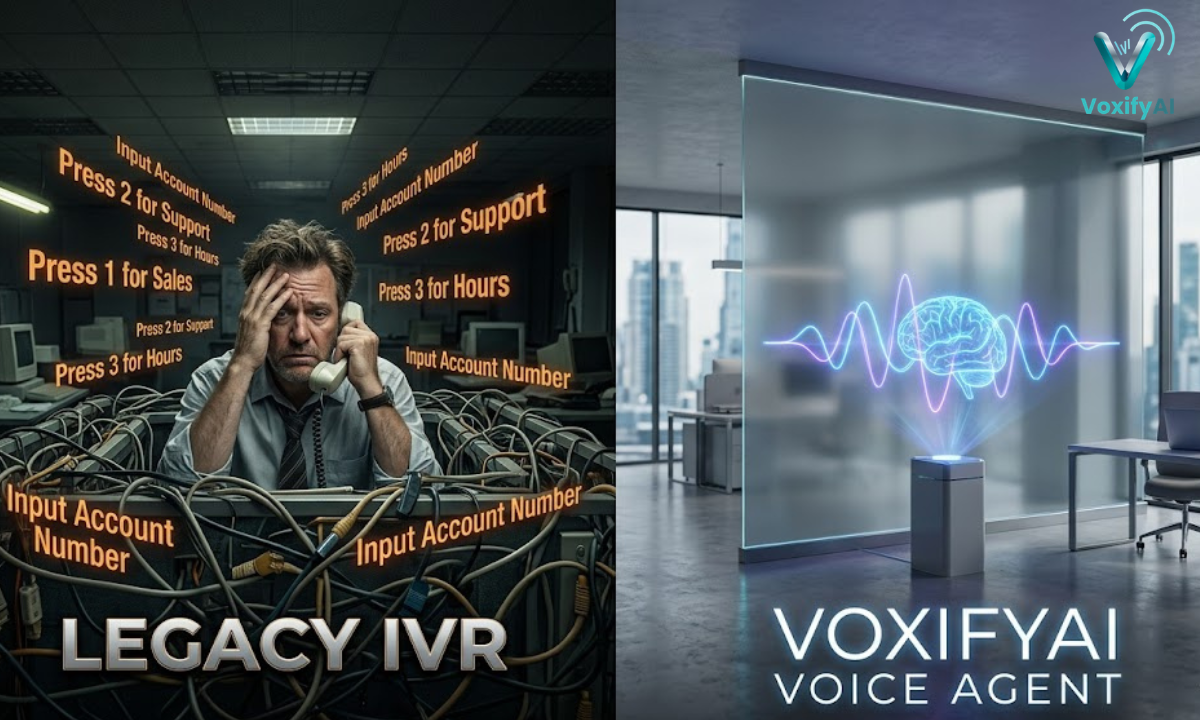
Traditional IVR systems are rigid, menu-driven “sorting hats” that often frustrate customers. Modern AI Voice Agents use Natural Language Understanding (NLU) to hold human-like conversations, resolve complex queries in real-time, and integrate directly with your CRM. For US businesses in 2026, switching to AI Voice Agents reduces call abandonment by 40% and cuts operational costs by over 60%.
The End of “Press 1 for Frustration”
We have all been there: trapped in a “listen-then-act” loop, shouting “Representative!” into a phone while a robotic voice reads a list of irrelevant options. This is the legacy of Traditional IVR (Interactive Voice Response).
In 2026, this experience is no longer just an annoyance—it is a brand killer. With the rise of AI Voice Agents, the expectation has shifted. Your customers no longer want to navigate your internal hierarchy; they want their problems solved in the first 30 seconds of a call.
At VoxifyAI, we help businesses bridge this gap by replacing outdated “Press 1” menus with Agentic Voice Systems that actually listen, think, and act on behalf of the customer.
1. Interaction Style: Rigid Trees vs. Natural Flow
The fundamental difference between these two technologies lies in their underlying intelligence.
- Traditional IVR: Operates on a deterministic “Decision Tree”. it only understands specific inputs like keypad tones or single keywords. If a customer’s problem doesn’t fit a pre-defined bucket, the system fails, leading to abandonment rates as high as 50%.
- AI Voice Agents: Powered by Large Language Models (LLMs) and Natural Language Processing (NLP), these agents understand intent, sentiment, and context. A customer can speak naturally—interrupting, changing topics, or adding complex details—and the AI will adapt in real-time.
2. Intelligence: Routing vs. Resolution
The goal of a traditional IVR is to route the call to the right human. The goal of a VoxifyAI Voice Agent is to resolve the issue on the spot.
| Feature | Traditional IVR Systems | AI Voice Agents (VoxifyAI) |
| Primary Goal | Call Routing (Traffic Cop) | Query Resolution (Expert Agent) |
| User Input | Keypad or limited voice triggers | Natural, open-ended speech |
| Context Awareness | None; starts over every time | Maintains context across the call |
| CRM Integration | Basic call logging only | Deep, real-time data sync & triggers |
| Resolution Rate | 30–40% (Self-service) | 70–80% (Autonomous resolution) |
| Latency | Immediate (but static) | Sub-1 second (Conversational) |
3. The “Silent” ROI: Scalability and Cost Performance
For a US-based business, the cost of a human-staffed call center is often the highest line item on the balance sheet. Traditional IVR actually increases this cost over time because it fails to solve problems, pushing nearly every caller toward a human agent.
The AI Economic Advantage:
- Unlimited Concurrent Calls: While traditional IVR is limited by physical phone lines, AI Voice Agents scale infinitely through cloud infrastructure.
- Lower TCO (Total Cost of Ownership): AI voice calls cost roughly $0.05–$0.35 per call, compared to $0.30–$0.50 for IVR when you factor in maintenance and specialized IT support.
- Reduced Live Agent Transfers: By resolving up to 80% of routine queries (tracking, booking, FAQs), AI agents save businesses handling 1,000+ calls roughly $4,000–$8,000 per month in human labor.
4. Technical Integration: The “Brain” Behind the Voice
A modern voice agent isn’t just a voice; it’s a software layer that lives inside your tech stack.
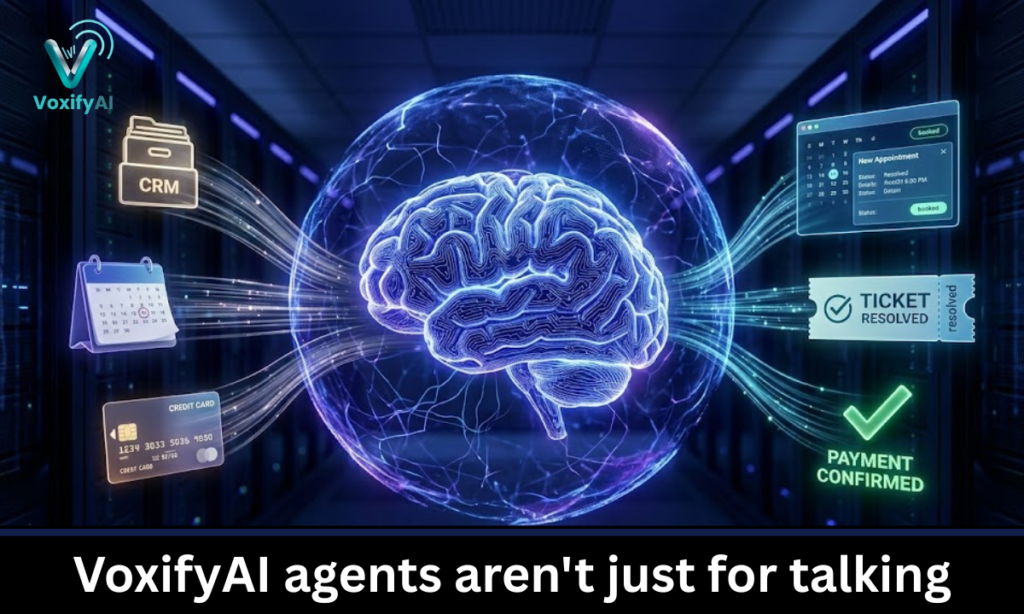
VoxifyAI specializes in Glue Engineering—connecting your voice agent directly to CRMs like HubSpot or Salesforce and automation tools like Make.com. This allows the AI to:
- Autonomously Book Meetings: Check your real-time calendar and book prospects without human help.
- Verify Data: Instantly confirm order numbers or account balances by querying your backend database during the call.
- Trigger Workflows: Send a follow-up SMS or email the moment the call ends based on the conversation’s outcome.
5. Sentiment Detection: The “Human” Factor
Traditional IVR is emotionally blind. It treats an angry customer and a happy customer with the same robotic apathy.
Modern AI Voice Agents use sentiment analysis to detect frustration or urgency in a caller’s voice. If the AI senses a customer is upset, it can instantly adjust its tone to be more empathetic or trigger an “Emergency Handoff” to a senior human manager with the full transcript already attached.
Frequently Asked Questions (FAQ)
What is the main difference between IVR and AI Voice Agents?
Traditional IVR is a rule-based system that uses keypad menus to route calls. AI Voice Agents use artificial intelligence to understand natural speech, reason through complex problems, and resolve issues autonomously without a menu.
Can an AI Voice Agent replace my entire call center?
While AI can handle 70-80% of routine inquiries (scheduling, billing, FAQs), we recommend a Hybrid Model. The AI handles high-volume tasks, allowing your human experts to focus on complex, high-emotion cases.
Is AI Voice more expensive to set up than IVR?
Initially, yes. AI Voice setup typically ranges from $2,500–$6,000 compared to legacy IVR systems which can cost $10,000–$25,000 for hardware and installation. However, AI Voice achieves ROI in 3–5 months, whereas IVR takes 12–18 months.
Does AI Voice support multiple languages?
Yes. Unlike IVR, which requires manual recording for every new language, AI Voice Agents can detect the caller’s language and respond fluently in over 50 languages instantly.
Don’t Let Your Phone System Be a Bottleneck
If your business is still using a “Press 1” system, you are essentially asking your customers to do the work for you. In 2026, the businesses that win are the ones that make it effortless for their customers to get help.
[Book a Free Demo with VoxifyAI] and hear for yourself how a custom AI Voice Agent can transform your customer experience.